17

October

Shoot To Thrill

Posted by Greg Carter

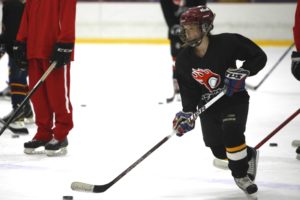
When it comes to scoring goals, it all starts with a great shot.

IMG_6250 - Version 2

An old coach of mine used to tell our team that you can never shoot enough pucks, and that the all of the great goal scorers could pick a spot, and hit it 9 out of 10 times. He would then tell us to go home and shoot pucks in the driveway, basement or back yard, and once you hit your target 9 out of 10 times, pick up the pucks and do it all over again.

Of all the great players that I’ve skated with, I always remember the guys who could shoot the puck. Some had a really heavy shot, but not great accuracy. Others could snipe a spot no larger than a mouse hole every time, but weren’t strong enough to beat the better goalies. The really great shooters had a combination of both power and accuracy.

With today’s stick technology, finding the right stick is a very important factor in shooting. The science in sticks today has been a game changer because of the flex and whipping motion that with the right technique, allows players to shoot harder than ever. Make sure to pay attention to the the pattern and flex which will play a role, especially as players get older, in developing a good shot.

So how can you increase the accuracy and power behind your shot? At our hockey camps we stress the importance of the fundamentals in shooting technique. This varies a bit from player to player and also by the age of the player. Older, stronger players have the strength to lean on a stick, creating the torque necessary to best leverage the technology in sticks. Younger players meanwhile, may not have the strength, and need to really rely on accuracy, while developing the strength and technique needed to score on goalies as they get older, and as the goaltenders get better.

Another key to a great shot is keeping your head up and your feet moving. We see a lot of players who have a good shot, but cant snipe the spot because their head is down and they don’t ever see that wide open top corner! Also, as soon as you stop moving your feet, it’s a big clue to the goaltender that you may be going for a deke versus a shot.

If you are spending your time away from the rink shooting pucks , you are already on your way to scoring more goals this season. Remember to practice all shots including the wrist shot, snap shot and slap shot. Each require a unique discipline that with the right stick, will allow you to shoot to thrill!

02

October

I recently received a phone message from someone who is always upbeat, energetic and positive. On this particular day he left me a voicemail updating me on everything that needed attention, and then as he always does, finished the message with “…and hey, make it a great day”.  His emails are also signed the same each and every time with “make it a great day”.

Life is busy and this small shot of inspiration can easily be ignored as just another cliche, or overlooked and lost in the clutter of daily communication. Or, it can be embraced. In this case, somewhere along the line, this guy decided that he was in fact not just going to leave this saying as a tagline on his emails or a sign off on his voice mails as a way for people to remember him, but to actually live each and everyday, truly trying to make it a great day!

Of course some days this can be an easy task because everything goes well, and things just sort of fall into place. Other days however, it takes focus, hard work and plenty of energy to turn a bad, good or ordinary day into a great day.

What I’ve seen from people like this guy is that when you start to live each day by the attitude you bring, it can become contagious among friends, coworkers and for the purpose of those playing the great sport of hockey, coaches and teammates!

It’s been said plenty of times that life is 10% what happens to you, and 90% how you react to it. So as you start this hockey season, remember that there will be plenty of things that you can’t control, including the team your are on, the teammates that you have, the coach or your linemates.  What you can control however, is your attitude towards it all. Attitude determines altitude. The start of the season is a fresh beginning, and another opportunity to have an awesome time playing the greatest sport on Earth.

Enjoy the car rides to the rink with teammates and family. Bring a smile and work hard at practices and dryland sessions. Treat each and every game like it’s an opportunity to showcase everything that you have trained so hard for during the off-season and at summer at hockey school.

Start the season with a great attitude and your chances of success will increase dramatically, both individually and as a team!

Make it a great day!

11

September

big-time-player-blog

Each year at the start of the season after tryouts, players and parents are revved up with anticipation about where they will fit in on their team, what their role will be, and of course, what position they will play and the biggest question, what line will they be on?

At younger ages however, it is important to pump the brakes a bit, and to keep the larger development picture in perspective. The better players are not just the players who did the best at tryouts. They are players who understand all aspects of the game. They are players that are able to adapt to all situations in the game, offensively and defensively, are able to skate competitively both forwards and backwards, and understand the importance of “positional versatility” as it is described in a recent USA Hockey article:

“The ability to be versatile is a key component of today’s successful hockey player,” said USA Hockey’s Bob Mancini, an American Development Model regional manager. “And it starts in youth hockey. Playing multiple positions at a young age does more than just give options to kids and their coaches. By playing and learning multiple positions, players view the game from different areas and understand  how to better defeat opponents in the small battles that typically pit one position against another. So the benefits can be immediate, and they can also be long-term. Years down the road, those youth hockey days of playing multiple positions can pay big dividends.”

Being able to play multiple positions will help players not only with their long term development, but also immediately this season, as  you seek to find your place, and role, on a team. There are numerous success stories about prep, collegiate and professional players who earned a spot on a top team – and the top line – playing a position other than the one they anticipated. The great players know how to play all positions, and how to accept their role on a team.

As an old coach of mine used to say, it’s more important to be a complete player, than a first line player.

So as you start the season, rather than focusing on the first, second or third line, keep in mind all of the hard work that you put in at hockey camp and your off-season goals, and remember that playing all positions is just as important in long term development as is playing first line center or first line wing. The best players will always find a way to play together, and sometimes that might mean playing defense instead of center.

The question is, will you be prepared, and ready to play?

I have a friend in Minnesota, the Great State of Hockey, who loves spending time in the summer on the open water as much as he does in the winter playing hockey on the frozen ponds. Stories of catching walleyes during the months of May and June are told with as much enthusiasm as scoring goals in January and February. When the calendar turns to mid-July and August however  – the dog days of summer – fishing slows down, but that is when he gets the most excited!

As the water temperature heats up in the late summer, the fish become a bit lethargic and can be difficult to find. For those who are able to find fish, that is when the real game begins, which is getting them to take the bait. As my friend tells me, for the most part, he used to buy the same bait, use a similar presentation and fish some of the same spots, regardless of the time of year. As he became a more experienced fisherman, he tried new techniques, new lures and new spots on the lake.

As he put it, most fisherman don’t really put in the time to try new things, they are sort of stuck in the same old way of doing things, and the result is very few fish finding their way into the frying pan. My friend spent many winter hours reading about tactics that he was unfamiliar with, watching YouTube videos of professionals, and studying new ways to catch fish during the ‘slow’ months. And once he invested time and energy into exploring and learning, he found a better, more productive way to fish, and now looks forward to this time of year, when the boat traffic is less, and the abundance of fish has increased.

For hockey players, this fisherman’s story is no different than the hockey season. There will be that part of the season that is the ‘grind’, when you are physically and mentally tired. You have already played a lot of games and you still have a lot to go, plus playoffs!

The question is, what are you doing now, during the off-season, to prepare for the grind, or the dog days of the season. Are you, like this fisherman, preparing yourself so that when the team needs you most, you are able to step up and bring your best effort.

Players who prepare now, trying new moves, perfecting their stride, shooting pucks on a regular basis, they are the players who will outperform the opponents during the season, just as my friend is out fishing nearly everyone on the lake. It takes dedication and commitment during the off-season to not just hit the ice this fall in great shape, but perhaps more importantly, to carry your team through the tough stretches of the season.

As my friend from the State of Hockey put it, ‘It’s amazing how many people just quit fishing this time of year, because it’s so hot, or because the fish just aren’t biting. The fish are always biting, you just have to find the right presentation.’

Work hard this summer, train with a purpose and you will be ready for the mid-season grind when, like many fishermen, many hockey players go through a slump. Train hard and be ready to take advantage of the opportunity, because when everyone else slows down, the best players speed up.

Good luck and we look forward to seeing you at the rink soon!

Click here for a full list of our remaining summer hockey schools.

02

May

Finding Your Next Level

Posted by Greg Carter

Watching the NHL Playoffs, it becomes obvious very quickly that the players are competing at an entirely different level out there compared to the regular season. The speed and quickness of the game is greater. The intensity is higher. It makes you wonder, how do these players take an already accelerated game to a whole new level?

There is a quote about leadership and coaching that says if you can raise the level of effort and performance in those around you, you are officially a leader. When it comes to coaching hockey players, especially elite hockey players such as those playing in the NHL, finding a way to connect with each player and understanding how to get the most out of them is a key ingredient in the recipe for success.

But when it comes to finding that next level it begins and ends with the individual player. The great Vince Lombardi once said that if you’ll not settle for anything less than your best, you will be amazed at what you can accomplish in your lives. When you watch playoff hockey, these players are not settling for anything less than their best. They lay it on the line for every race to the puck. Every shot on goal and every pass is a laser. The battles in front of the net and in the corners are their own individual cage matches.

When you break down the game and analyze how amazing the individual talent and skill sets are out there, it can be compared to an engine in a machine. If the engine is built properly – in the case of hockey players, developed and trained properly – and also cared for properly, there will be a time when you can run that engine at the highest RPM’s and push it to maximum performance.

Youth hockey players who spend the time training and working on skills are doing just that, they are preparing themselves – their engine – for the periods of time (the playoffs) when they are going to need to rely on optimizing their performance at the highest level.

As the run for the Stanley Cup continues, it should serve as inspiration to take your own game to the next level, to shift your engine into the next gear. There is another great quote about commitment that says you’re either IN or you’re OUT. There is no such thing as life in-between.

We invite you to join us at one of our hockey schools this summer and with our training, find your very own next level!


16

March

Once that final buzzer sounds it’s only a short time before most players start to think “What’s next” . . . “How do I improve my game?” While many players think this, it’s those that follow through, set goals and work hard that actually hit the ice next season as a better player than last season. So the question is, how are you going to make the most of your off season training?

5 tips to the top of your game: 

  1. Start with a plan. This seems simple and obvious, but a plan isn’t a plan unless goals are identified and written down. Think back to last season and the difficulties that you had, identify areas of improvement and create a plan that will improve skills in areas that need the most work. Many players work on areas in which they are already strong. The great players spend time focusing on their weaknesses.
  2. Choose a program. There are many options on how and where to train. Do your homework, and research opportunities that are reputable and offer training and skill development in the areas that align with your goals and objectives. Once you make this important commitment, you will be once step closer to your off season goals.
  3. It’s summer, enjoy it! Off season training should be mixed in with a good balance of traditional summer activities. Hockey players that create a mix of training and fun are more likely to reduce injuries and also will stay with the program for a longer period of time.
  4. Dedicate yourself. When it does come time for training, whether it’s before going to the beach or after a round of golf, focus on what you need to improve on. Put yourself back into the place you were last season and think about the areas of your game that frustrated you. Listen to your instructors and coaches and skate each drill with the same intensity that you play the game. Dedicate yourself to the moment!
  5. Split the summer into 3 periods. June, July and August come and go very quickly. If you split your training and define goals for each month, it will allow you to focus and access your progress on a monthly basis. Players that we have trained at our summer hockey schools have told us they will identify 3 key areas of focus, and while they train all summer with them in mind, they may spend more time in June in shooting for example, and then shift the focus of July to power skating, and then August is all about stickhandling.

The goal of your off season training should be to improve your skills, increase your love of the game and to hit the ice this fall as a better hockey player than you left it in the spring. Good luck in all of your training and we hope to see you on the ice at one of our camps in 10 states this summer!

Playoff games can be stressful, but ask any player or parent, and they will tell you that when it comes to stress, tryouts are at the top of the list. Players are no longer competing with their buddies against another team during tryouts, they are now facing each other, competing for a limited number of spots on a team. I have evaluated tryouts for many years and noticed that players seem to fall into a few different categories: those that rise to the occasion and tryout really well, those that don’t tryout well for a variety of reasons, and then those in a middle group that don’t do much to hurt their chances, but also don’t do a whole lot to shine and really help their chances of making the team.

So do tryouts bring out the best in you, or the worst in you? Or are you somewhere in the middle group? What is interesting is that the players that seem to have their best stuff during tryouts, are also the players who have a calm and collected demeanor. In other words, they come to the rink prepared and in a good mindset, ready to compete and showcase the skills that they have developed.

The “Six P’s” can apply not only at tryout time, but also with school, work and just about every task that presents itself. Proper, prior, preparation is all about making sure that you are in the best position possible to succeed. It is often said that a big part of stress is directly attributable to simply not being prepared. When it comes to hockey, and tryouts, how prepared are you? Are you hitting the ice with enough rest to perform at your peak? Have you paid attention to your diet so that you have the fuel that you will need to bring the energy necessary to outwork the competition?

How about your hockey skills? Have you put in the necessary time required to improve the skills in your game? As we have noticed at our Massachusetts-based hockey school, as players advance through the various levels of  youth hockey, the skill level of players increases dramatically, and no where is it more evident than at tryouts where dangles and snipes can be the difference in whether or not you make the team.

What I really like about the six p’s is the word proper. Preparation can mean many different things to players, and the key is preparing the proper way. If you need to work on your skating, you need to understand the proper fundamentals of power skating. If you are working on your stick handling, you need to practice the proper mechanics, such as keeping your head up. If you prepare in the proper manner, you will reap the benefits. Practice like a champion to perform like a champion.

Good luck with your tryouts and we look forward to seeing you at one of our hockey schools this summer!

Each summer we work with hockey players from across Massachusetts as well as the entire country. Our staff is asked many questions about hockey development by both players and parents, and here are the most frequently asked questions.

What does my child need to do to get better?
Every parents wants the best for their child, especially hockey parents for their hockey players! The first thing to recognize is that development is not a sprint, it’s a marathon. For players to get better they need to commit to a long term development strategy geared towards working on specialized skill sets at each level from Mites on up. If a player masters each of these age-specific skills, they will have a great foundation to build on throughout their career.

Should my child play a variety of positions or just forward or just defense?
This is an interesting question because of how often it gets brought up. At young ages kids need to develop a full understanding of the game of hockey including skills, strategies and tactics at both forward and defense. Many great defensemen playing at the collegiate and professional levels attribute their ability to ‘see the ice’, step up into the play and contribute offensively to having played forward as a youth or even a prep player.

How can I score more goals?
Every player wants to score goals, and there is one surefire way to find the back of the net more often: shoot pucks. A great coach once told me that you can never shoot enough pucks, and he was right. Another way to score more goals is to become a great stickhandler. Spend time at practice, home and hockey camp working on stickhandling and it will pay off on the score sheet!

What can I do to improve my skating, speed and quickness?
We love this question at our hockey school because skating and stride is too often overlooked by hockey players. Even the smoothest, fastest and quickest skaters are continually working to improve in this area because they understand the importance of speed, quickness and stride in the game of hockey. To improve your skating focus on things like edge work and technique. We like to really focus on these two areas at our hockey camps and the results can be extremely positive.

What do I need to do to make the team next year?
This is always the biggest question as we work with players prior to tryouts. Regardless of what level you are playing at or team you want to make, there is no substitute for commitment and hard work. Create a list of skills that you need to work on and spend time on and off the ice mastering these skills. Shoot pucks and stickhandle rather than watching TV or sitting on your phone. Hockey is becoming more competitive every day and the players who make the team are the ones who put in the time and dedicate themselves to learning new skills and getting better everyday!

Do you have a question about your hockey development or summer hockey camp? Email us and we would be happy to answer your questions!

We have hockey camps in ten states this summer including Alaska, Connecticut, Illinois, Massachusetts, New Hampshire, New Jersey, New York, Pennsylvania, Vermont and Virginia. We hope to see you on the ice soon!

15

December

Hockey 2016 – By The Numbers

Posted by Greg Carter

2016 was another great year on the ice. Running hockey camps in 10 states again reminded us just how awesome this sport really is in the U.S.
Here are our some of the stats – and a black bear – behind the great states that we enjoy working in each summer!

We started out our hockey camp in Alaska with a black bear greeting us at our cabin. Hockey is alive and well in the Last Frontier. There are nearly 9,000 players in Alaska and the state currently has 16 men’s Division 1 players and 8 women playing Division I hockey.

Connecticut is one of our favorite spots with more than 13,000 players registered with USA Hockey. The also have a nice roster of Division I players including 30 on the men’s side and 15 on women’s teams.

Illinois is a hotbed of “Blackhawk’s hockey” with 84 Division I men’s players (5th most) and 35 women (3rd most). Illinois also has more than 31,000 total hockey players and is always a fun place to train aspiring young athletes!

New Hampshire hockey families are passionate about the game. With around 6,000 players in the state this season, they have the same number (13) of both men and women playing Division I.

New Jersey loves their Devils and has just under 20,000 players in the state. They also have 45 men’s Division I players this season and 4 on the women’s side.

New York is always among the leaders in the U.S. registering just under 50,000 players! We love our camps in the state that has 94 men’s Division 1 players this season and 33 women.

There are just over 30,000 players in the great state of Pennsylvania, all admiring the recent Flyers winning streak, or wanting to grow up and be like the incredible Sid Crosby. 47 men’s players and 9 women Division I players hail from Pennsylvania.

Vermont registers just under 5,000 players and has 3 men and 10 women playing Division I hockey this year.

Virginia has just over 10,000 registered players and 5 men and 2 women playing Division I hockey.

Finally, we close with our home state of Massachusetts, where we love the Bruins; and the Red Sox! Massachusetts (113) ranks third only to Michigan (145) and Minnesota (203) in producing Division I men’s hockey players. There are 72 women from Mass. playing Division I hockey this season, second only to Minnesota (147). As our friends at Mass. Hockey would say, we are #MassProud!

We hope you enjoyed your year of hockey as much as we did.

From our team to yours, have a very happy holiday season and we look forward to seeing you on the ice in 2017!

13

November

What’s Your Hockey Emoji?

Posted by Greg Carter

I received a text the other day that got me thinking that if hockey players had to choose an emoji to describe themselves and their best hockey skills, what emoji it be?

There are literally hundreds of emoji’s to choose from when sending emails and texts, all of which make communication obvious, quick and simple. Just the other day I sent a text asking if someone was ready for hockey practice and I got back a thumbs up, hand clap and a mail box, which I later learned was meant to say ‘yes, I’m super excited to bring the mail’. All this got me thinking, if you had to pick, what would be your hockey emoji? Here are a few of our favorites:

eggThe Ham & Egger: This is for the every day player that isn’t necessarily the standout on the team, but every practice and game is consistently good and you just know what to expect from them. Every team has and needs players who may not have the top end talent and skill, but they have a drive and desire to win the battles in the corner and the races to the puck. Will over skill.

fist-bumpThe Pick Me Up Fist Bump: A pick me up player is important to the team. The fist bump is for the player that is always a good teammate and not only loves to celebrate the big moments with a fist bump, but to also use it in the difficult times to say ‘I got your back’.

moviecamThe Highlight Reel Movie Camera: This is for the players who have the ability to make moves on the ice that other players try to emulate. They are silky smooth with the puck, can stickhandle through a crowd and can deke goalies to score highlight reel goals.

tongueThe Exhausted Dog Tongue: This describes complete exhaustion, think of your dog after throwing the ball with him for a half hour. Dog tired! When we run conditioning drills at our hockey camps it’s always fun to see the top players working the hardest. If your hockey emoji is both the highlight reel and the dog tongue, you should be proud of yourself!

violinThe “Whine”, Cheese and Violin:  This describes the player who constantly whines about what position they are playing, not getting the puck enough or which line they are on. The violin emoji is often accompanied by the goblet and piece of cheese emoji’s.

gamblerThe Riverboat Gambler. This is the player with talent and the confidence that the chips are stacked in their favor. A dangerous combination that can win championships, but also a risk factor that puts gray hair on coaches. The Riverboat Gambler is willing to risk it all for the big play, and win they score, they win big. But there is always the chance of losing it all with their mid-ice dangle with no safety valve.

100The All-In, All The Time 100: This is for the player that gives 100% in everything they do. They are a good teammate in the locker room, have a 100% positive attitude, are always working their hardest and love the game 100% of the time!

Although emoji’s aren’t yet showing up in scouting reports or player/coach meetings, they are definitely a fun and entertaining way to communicate. So, what is the best emoji to describe you has a hockey player?

This article was written by the Greg Carter Hockey School pro staff. We have hockey schools in Massachusetts and throughout the United States. Please check out our hockey camp page for dates & locations for our 2017 summer hockey camps.

Subscribe

With RSS feeds, you don't have to visit our site everyday to keep up to date. Simply subscribe to our blog via RSS or Email and our posts will come to you!

Archives