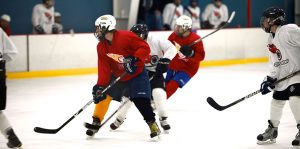
This summer hockey players will take a break from the warm sun and blue skies to work on their game and goals to become a better hockey player. How? Here in our home state of Massachusetts we are proud of Tom Brady’s sixth Super Bowl, and therefore rather than the five reasons to register for a summer hockey school, we added a “Tom’s Take” and now offer you SIX super reasons to increase your skills at summer hockey school!

Become a better hockey player! An old coach used to say that ‘if we get better each and every day, we are going to be just fine both as a team, as well as individuals.’ We believe this to be true and carry that motto with us into all of our hockey camps. Our talented and knowledgeable instructors work hard to make sure that when the week of hockey school is over, players leave with more skill and a better appreciation and understanding of the game.

Meet new friends & learn from teammates. Attending a week-long hockey school is a great way to step out of your comfort zone a bit and meet new players from different areas of the state, or even the country! While every player at summer hockey school shares a love of the game, it’s very interesting to see some of the differences in styles of play from state to state. Players who attend summer hockey school have a unique opportunity to not only learn from our talented team of coaches, but often from other players who by the end of the week, become another hockey friend!

Specialized skill development. We pride ourselves at teaching the many fundamental skills needed to become a great hockey player and likewise, summer hockey camp is an excellent opportunity to work on the specific skills needed to take your game to the next level. Skating, shooting and passing are just a few of the areas we like to focus on. If you have a specific skill development need, our coaches love to talk about it at the start of the week!

Setting goals. Each summer we work with players to evaluate their game, determine areas of improvement and set goals to achieve something special. Great players all set goals for themselves and then constantly remind themselves of their goals and progress towards reaching them. If you come to summer hockey camp with clear goals, you are well on your way to success!

The CARTER Method. For 25 years we have been teaching hockey with the CARTER Method. We are very proud of the success that we have achieved and look forward to developing the next generation of hockey players with this time-tested method of development.

Become a champion! We all want to win, and here is some great perspective from six-time Super Bowl Champion Tom Brady:

“I was the kid that was the 199th pick that never had the body for it. People didn’t think I’d play one year in the NFL.”

This is a great reminder that hockey development is a marathon, not a sprint. It is also a testament to working hard, dedication and perseverance. You may not be on the first line today, but if you set goals and dedicate yourself to achieving them, anything is possible, even six Super Bowls!

Thank you for reading and we hope that you continue to follow your hockey dreams this summer at one of our hockey camps located in ten states!  For dates, locations and registration information, click here.

16

October

I like asking kids at our summer hockey camp what position they want to play in the upcoming season. Most often we hear center, and then right after that they bellow out ‘first line center!’ A team obviously can’t have nine first line centers, so what can you do as a player if you don’t find yourself as a first liner?

Skill development is a marathon, not a sprint. Players that were leaders on a team one season can be ‘caught’ by other players as they age, grow and mature. I’ve seen first line players one year become third line players the next and have also seen plenty of players who started the season on the third line work their way to a spot on the power play, penalty kill or first line.

How? It all starts with a desire and willingness to show up and work hard. Not once in a while, but every day at every practice! An old coach used to say that ‘the one thing we are going to do each and every day is get better, and if we do that, we’ll be a team full of really good, hard working hockey players at the end of the year.’

And for those players that did show up, work hard and get better every single day, things can change quickly, and a third line spot can change to second and first in the matter of weeks. Another key to success is being a smart player and making good hockey decisions. This is even more true at the Peewee and Bantam levels where coaches start to integrate systems and players who understand and can execute their roles and responsibilities become the trusted players that coaches can count on in special team situations.

If you have found yourself in a situation this season where you are on a line that you don’t like or aren’t part of the power play or penalty kill, embrace the challenge and turn up your effort even more. Continue to focus on specific skills and bring a great attitude each and every day.

An opportunity will present itself at some point this season and when the moment arrives and the coach calls your number, take advantage of the break and don’t look back!

The great college basketball coach Roy Williams was quoted as saying “I can live with just about anything, but not a lack of effort. If you want to play in the game, you must give me 100%.”

This is even more true if you want to play on the first line or power play. Work harder than everyone else and don’t give the coach any reason not to play you!

Thanks for reading, good luck this season and we look forward to seeing you at the rink soon!

22

August

Whether you are playing football this fall or just enjoy cheering on your favorite team, the CARTER Method of training can be applied to multiple sports and athletes, whether it’s in the centerfield to the backfield!

Control. The importance of body control in an athlete is critical. Every movement is a skill and in order to master a skill, and movement, an athlete must be dedicated to it, whether on the offensive line in football, or the blue line in hockey. Athletes must understand and enhance body movements to improve their overall balance and performance.

Agility. There was a great video that came out this summer of Nashville Prdators’ defenseman P.K. Subban working out on the ice skating with quick feet, changing directions and position of his body quickly and effectively. And, he did all of this under complete control. Speed, coordination, quick reflexes and balance are all important characteristics of having great agility.

Reflex. The Little League World Series is one of the great sporting events of the year. Watching a recent game I saw a batter send a line drive screaming right back at the pitcher. This pitcher stuck out his glove and snagged the ball before it flew by him into the outfield for a base hit. Great athletes have excellent reflexes.

Technique. Proper technique is the foundation of training. Enhancing performance without the proper technique is virtually impossible, especially as athletes mature. With football season upon us, color commentators love to talk about the technique of players, especially quarterbacks! There have been many good quarterbacks who never became great or elite, because they didn’t have the technique that would allow them to get to the next level. Make sure to pay attention to and work and proper technique!

Edge. When we talk about ‘edge’ in hockey we are talking about skating and using the inside and outside edges of the skate blade. Having great control and agility as an athlete will give you every advantage when the game is on the line.

Retention. The retention of motor skills, technique and other skill attributes is paramount. Repetition leads to retention. Repeatedly test yourself on what you are learning and over time, you will find success!

We hope you have a great Labor Day Weekend and an awesome start to the season! 


11

April

This spring we’ve seen the first pitch of America’s summer pastime lead to games being postponed because of snow; and wow, have we seen snow! So what has the weather and baseball taught us about hockey? Well, just as we saw at the NCAA Frozen Four, to be prepared for anything.

As the commentators described how the Bulldogs were lucky to even get into the NCAA tournament with the last at-large bid – ironically via an overtime win by Notre Dame who they eventually beat for the National Championship – I was reminded of many times in sports when an unexpected opportunity presented itself, and the outcome being squarely rooted in being prepared.

Just like the UMD team was prepared to make the most of the opportunity to play in the NCAA’s, players themselves need to be ready for the unexpected. When the chance presents itself to fill in on the power play, will you be ready? When your linemate gives you the perfect no-look pass on the tape, will you bury it? When the coach calls your number in the shootout with the game on the line, do you have a ‘go-to’ move or a sure-fire shot?

Even though I wasn’t ready for all of the snow this winter, or what I thought would be a nice little late-season snowfall that lead to a dreadful blast in mid-March, and ended with what we can only hope is a final kick in the teeth last week, I am ready now, with a snowplow large enough to blow out three lanes of interstate highway in a single pass. 

Like our unexpected battles with Mother Nature this winter, UMD’s unexpected birth in the NCAA’s and the boy’s of summer having snow delays, hockey players need to always be ready for what the game presents.

We hope you take advantage of the opportunity to train with us this summer. Our hockey camps have locations in 10 states and specialize in key areas of skill development that we call the CARTER METHOD. This includes the fundamentals of skating, stick handling, and shooting, and we teach in a way that builds confidence and leads to continuous improvement. Control, Agility, Reflex, Technique, Edge and Retention.

Our talented and knowledgeable staff is eager to answer your questions and help you prepare for next season, as well as the next time the unexpected opportunity presents itself. Because when it’s your turn to shine, great teams and great players are prepared, confident and ready to perform!  


14

March

As a hockey player, to achieve something special, you need to know what you want, and once the top of the mountain is in sight, it’s time to set the goals to get there.

A coach used to say that goals without a plan are just dreams. And while there is nothing wrong with dreaming, if you really want to make dreams come true, there needs to be a road map with mile markers to help you get there.  Each summer we work with players from across the country who share a common goal, to become better hockey player. Most have an idea of what they want to achieve in hockey, and a select few have a really thought out plan on a training regiment that will increase their odds of accomplishing their goal.

So what are your summer plans? If you are really serious about becoming a better hockey player, your summer plans should include goals written on a piece of paper. One youth hockey player that I know actually has goals written in inspirational quotes on the bedroom wall. Documenting goals on paper, bedroom walls or on the goalposts of the net you shoot on in your basement or garage is important. If a goal is not written down somewhere they are too easily and often forgotten.

Start simple with your goals, maybe this summer you hope to develop a really good wrist shot. Or maybe you need to increase your speed or quickness. Power skating is something every player needs to continually improve on, so maybe that is on your list. The point is, when you start to set goals and work towards achieving them, when you finally do it is an extremely rewarding process, and increases the likelihood that you will reevaluate your game, and set higher goals next time. The most important step in this process is the first one, to get in the routine of setting goals, and then developing the good habits of working towards that goal!

Alexander Ovechkin scored his 600th goal last season, and did so fourth fastest in the history of the NHL. Ovechkin is obviously graced with plenty of natural talent, but his off season focus is about fitness. He knows that if he is in the best shape, he stands the best chance of dominating in the top hockey league in the world. His summer goals are focused around fitness and conditioning. Ovechkin was quoted as saying “Without training, I’m nothing. If I’m not training, I’m done.”

Long before he scored all these goals, he set his own goals. And after 600, he’s still committed.

So what are your goals for the summer? We invite you to set your goals and train with us to help achieve them at one of our 2019 summer hockey camps. This summer we are celebrating our 25th year of hockey camps and it’s going to be a very rewarding experience!

Thanks for reading!

Greg Carter Summer Hockey School

12

December

The Need For Speed

Posted by Greg Carter

Hockey can often seem like a very complex game, but it really doesn’t have to be. Simply put, it is a game of creating favorable odd-man situations and winning ten foot races to the puck, which we have talked about in previous articles. Every player who laces up their skates has a need for speed, and while some possess a natural talent for accelerating like a Jack Russell Terrier chasing a red a squirrel through the neighbor’s backyard, most players have to work extremely hard on and off of the ice to develop and maintain their speed and quickness.

Here are a few great tips to building and enhancing this important area of your game:

  • Top speed comes from maintaining acceleration. Use your inside edges to start off and create speed, then use your outside edges to maintain your stride. Practice moving between the two edges and feel the difference. Also swing your arms north and south to aid your momentum. At out hockey camp we see many players who slow themselves down by moving their upper body and arms east and west, this is a pretty simple correction that can have immediate impact.
  • The harder you dig into the ice, the faster you will propel yourself. Reaching top speed, and maintaining speed, requires full body coordination. This is where technique is very important, work on it and built a solid foundation for your stride and over time, you will become a fast skater.
  • Focus on powerful, long strides. This includes maintaining a 90-degree knee bend, and using your three skating joints: hip, knee and ankle. In order to extend your stride, you must work on your recovery, which means bringing your knee and skate under your shoulder, allowing you to maintain your balance and give you the ability to reach full extension with your stride.

An explosive start to your stride ultimately means more quickness. Building muscle, along with mastering the proper fundamentals, is important to increasing speed. Squats and plyometric training are two common exercises that athletes use in the weight room to build the muscles that help win the races. Take the time on the ice to work with coaches and instructors to refine the mechanics of your stride. Off of the ice, put in the time with a strength coach focusing on the leg muscles that will provide the horsepower for your stride.

Like all of the great skills needed to achieve your goals, developing speed comes down to who is willing to put in the time to work hard at it. If you take the time to create a fundamentally sound stride, and also develop strength, you will be well on your way to possessing game-changing speed!

We hope you are having a great season and look forward to working with you at one of our summer hockey camps in ten states next summer!

28

November

I was recently talking with an elite athlete who shared some important advice he had received from his parents:

To play the game is good,
To win the game is better,
To love the game is best of all.

I left the conversation thinking about all of the great players that I have had the pleasure of playing with or coached, and about those who have made it to the Division I level and beyond. Without exception, they all loved the game. Some of them are listed in our hockey camp Hall of Fame.

Youth hockey players, especially as they mature and reach the top of the pyramid, have many influences, and many people trying to give them advice. “You need to do this, and you need to do that.”

This is where one can find the defining fine line between needing to do something, and doing it because you love the game. 

For example, I can remember being at hockey school and receiving instruction on how to improve my shot. I spent many hours working on developing the best shot I possibly could. Yes, I needed to do this, but that’s not why I did it. I practiced shooting until I literally could not shoot another puck because I loved the thought of scoring the winning goal. I loved the thought of the on-ice celebration afterwards. I loved the thought of laughing and having fun in the room after a win with my buddies. And all of these feelings are why I loved the game way back then, and still today.

The encouragement that I received from people closest to me was always centered around the joys of competition, and the satisfaction of coming out on top. Things like ‘hockey is a game of ten-foot races, win the races and you stand a good chance of winning the game.” When someone said that to me, I took that as an opportunity to work hard on my speed. Again, not because someone told me that I had to, but because I wanted to win so bad, and wanted to feel the exhilaration that comes along with it. When you love something the compete level is at its greatest, as are your chances of success.

No one can teach a player to love the game, instead it has to come naturally and with positive encouragement. Teaching versus preaching is important.  Focusing on long-term development versus short-term gain is critical. Car rides home discussing the fun atmosphere of a game, the excitement of the speed and appreciation of the finesses are things that create the emotional connection with a player to the game. And once that positive emotional connection is made, and a vision of that player being in the moment is created, a great future can be built on the foundation.

As you continue down the road this winter with your son or daughter, remember that to play the game is good, to win the game is better, and to love the game is best of all.


16

November

One of my former coaches used to say that if you stay in the moment, good things can happen. I’ve always believed and preached this coaching games when my team is both leading as well as behind, but especially when we are behind by several goals. I was reminded of this former coach after watching an absolutely incredible finish to a recent high school football that made national news.

The game was between two teams from Minnesota. With one minute left in this quarterfinal state tournament game, Maple Grove High School was down by 19 points.

Game over, right?

As fans were heading for the exits, Maple Grove scored a touchdown to make it 27-16 with 59 seconds left in the game. Failed onside kick, and game over, right?

Maple Grove recovered the onside kick and had the ball at mid-field. Ok, interesting, but they still need to score a touchdown, and even if they do, they are still down by five points, and will be kicking off with little or not time remaining. A quick pass led to another touchdown, and suddenly the score was 27-22 with 46 seconds left.

Ok, at this point, it’s been a great story, but there’s no way a football team can successfully execute another onside kick, right? And even if they miraculously did, they would still need another touchdown.

Incredibly, this team recovered another onside kick, and once again had the ball around mid-field. A few pass plays got them down near the goal line, and the next play they ran in their third touchdown in a minute. Pandemonium ensued, and I’m sure sometime later that night the reality of what they had accomplished set in.

In our last blog we talked talked about the awesome baseball we saw during the World Series this year, and about the importance of believing in your own game. We asked the question about when the game is on the line, do you believe and dig down, and think of all of your time, energy and training, and confidently know that you can win.

This football game brought up another important aspect of this, which is not just believing that you have the talent to win, but also and just as importantly, staying in the moment and doing your job.

It would have been very easy for the kicker of this high school football team, down by two touchdowns and thinking the game is over, to not concentrate on the first onside kick. Instead, he executed it flawlessly, as if that kick was going to win the game. He stayed in the moment!

It would have been equally easy for the quarterback to then take the field, still knowing a comeback was nearly impossible, and to lose focus on the plays and passes.

These players stayed in the moment, and even after converting one successful onside kick into a touchdown, did it again, this time to finish a comeback like football fans had never witnessed, and may very well never see again!

Whether you are on the winning side of a game, or the losing side, this wild finish is a great reminder to never lose focus, and regardless of the score, to play hard and do your job until the final second ticks off the clock.

Great coaches leave lasting impressions, and that old coach of mine always taught me to stay in the moment, and I’ve got a feeling both of the teams that participated in this wild game will never forget that same lesson!

We hope you are off to a great start to your season. All of our 2018 summer school dates and locations will be finalized soon. Have a wonderful Thanksgiving Holiday with family and friends and remember, if you stay in the moment, good things can happen!

31

October

What’s In Your Game?

Posted by Greg Carter

It’s been great to have the NHL back in action on tv, but it was really tricky trying to watch hockey recently when there was such an incredible World Series taking place. While there is little doubt that hockey is way more entertaining than a baseball game, the drama unfolding in this championship series was absolutely epic and made me think about some of my hockey experiences.

Game 5 in particular kept many of us up until the game-winning run was scored in the wee hours of the morning; actually 1:37 a.m. on the East Coast where our hockey school is headquartered! How could anyone fall asleep during a game where three-run deficits were overcome three times? In hockey they say that a two goal lead is the hardest to keep, well in baseball this was just the second time in postseason history that a game featured three separate comebacks by teams down by three runs.

The Dodgers led 4-0 early, and were tied at 4 on a three-run homer by Yuli Gurriel. Then the Dodgers went back ahead, 7-4, on a three-run homer by Cody Bellinger. Houston proceeded to tie the game 7-7 on a three-run homer by Jose Altuve. Then the unthinkable happened when Houston coughed up a 12-9 lead in the ninth to force extra innings!

The Astros went on to a 13-12 victory in this five-hour, 17-minute thriller when Alex Bregman singled in Derek Fisher in the bottom of the 10th inning. Al Michaels’ had the famous line in the 1980 Olympics ‘Do you believe in Miracles’. But during this game, we might just ask, do you believe?

And in your own games, when the game is on the line, do you believe? Do you dig down, think of all the time, energy and training, and confidently know that you can do this? When you are behind by a goal, or two or three, do you start to lose confidence, or do you look around at your teammates and instill the energy and poise needed to mount a comeback.

As a coach when we are behind in games, I’ve seen players look at their opposition and question if they’re outnumbered and too good, or maybe start to think that their goalie can’t be beat. Watching game 5, the Astros were facing Clayton Kershaw, the Dodgers’ ace who was having the best postseason of his life. In fact in 61 regular-season games when Kershaw had six or more runs of support, he won 59 of them. But when it mattered most, Houston found a way to succeed.

A great coach once told me ‘you have to believe that your are good, before you will ever be good.’

When it’s the clutch moment, and the game is on the line, will you be ready? Will you believe that all of your training and preparation has put you and your teammates in a position to win? Will you believe that you can mount the comeback?

The Houston Astros did. The LA Dodgers did.

What’s in your game? Will you believe?

11

September

big-time-player-blog

Each year at the start of the season after tryouts, players and parents are revved up with anticipation about where they will fit in on their team, what their role will be, and of course, what position they will play and the biggest question, what line will they be on?

At younger ages however, it is important to pump the brakes a bit, and to keep the larger development picture in perspective. The better players are not just the players who did the best at tryouts. They are players who understand all aspects of the game. They are players that are able to adapt to all situations in the game, offensively and defensively, are able to skate competitively both forwards and backwards, and understand the importance of “positional versatility” as it is described in a recent USA Hockey article:

“The ability to be versatile is a key component of today’s successful hockey player,” said USA Hockey’s Bob Mancini, an American Development Model regional manager. “And it starts in youth hockey. Playing multiple positions at a young age does more than just give options to kids and their coaches. By playing and learning multiple positions, players view the game from different areas and understand  how to better defeat opponents in the small battles that typically pit one position against another. So the benefits can be immediate, and they can also be long-term. Years down the road, those youth hockey days of playing multiple positions can pay big dividends.”

Being able to play multiple positions will help players not only with their long term development, but also immediately this season, as  you seek to find your place, and role, on a team. There are numerous success stories about prep, collegiate and professional players who earned a spot on a top team – and the top line – playing a position other than the one they anticipated. The great players know how to play all positions, and how to accept their role on a team.

As an old coach of mine used to say, it’s more important to be a complete player, than a first line player.

So as you start the season, rather than focusing on the first, second or third line, keep in mind all of the hard work that you put in at hockey camp and your off-season goals, and remember that playing all positions is just as important in long term development as is playing first line center or first line wing. The best players will always find a way to play together, and sometimes that might mean playing defense instead of center.

The question is, will you be prepared, and ready to play?

Subscribe

With RSS feeds, you don't have to visit our site everyday to keep up to date. Simply subscribe to our blog via RSS or Email and our posts will come to you!