31

January

Goal Scorers & Prolific Passers

Posted by Greg Carter

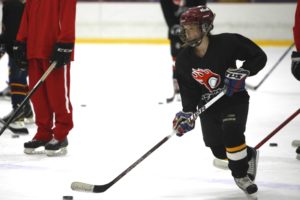
Most teams have a goal scorer that can be counted on to find the back of the net on a regular basis. And as every good hockey coach will attest to, wherever you find a goal scorer, there is usually a great playmaker nearby. While everyone wants to score goals, having the talent to read a play and put the puck on the tape is an equally impressive skill.

Are you a good passer? Making a good pass can be the difference between winning and losing a game. In practice it can be the difference between a great start to a drill, or it ending before it ever begins as the puck slides down the entire length of the ice.

Practicing passing, and the proper fundamentals, should be a regular part of your skill training. Becoming a better passer is a simple way for players to make huge contributions to their team, and it all starts with a good hockey personality. A good personality you might ask? Absolutely, because in order to be a good passer you can’t be a puck hog! Great passers have a high ‘hockey IQ’ and try to making the right hockey play, not just trying to light the lamp themselves. And best of all? Great playmakers know that when they make a great pass, they oftentimes can expect a great pass back!

Tips and tricks to passing with precision:

Vision. Making a good pass starts with keeping your head up and being aware of the play. The skill of passing involves reading and anticipating the play, and not just making a pass, but making the right pass.

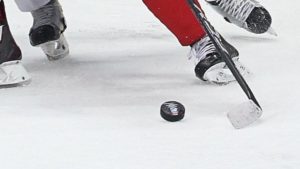
Accuracy = Tape-to-tape. Players hear this all of the time from coaches, and in order to make an accurate pass you need to look at your target and make a good, crisp pass with a proper follow through. Taking the extra split second to find your target and see how fast he is moving is something that will come naturally with practice. A pass into the skates of your linemate is a surefire way to quickly end a breakout or breakaway. Practice makes perfect, so hit the tape every time in practice and you stand a good chance of doing the same in the game!

Mechanics. The mechanics of passing have changed over the years as sticks have evolved. Gone are the days of needing to over emphasize receiving the puck, especially as players get older and stronger and the stick flexes when receiving passes. Some fundamentals do remain constant, such as not slapping at the puck. This is a common mistake players make at younger ages. Instead of slapping at the puck, players should concentrate on the puck rolling off the blade from the heel toward the toe in a sweeping motion. Weight transfer is also important, so move from your back to front skate as you begin your follow through.

Once players master the basic fundamentals of passing, they can start to practice more advanced passes such as a saucer pass, which is one of our absolute favorites! Take the time to work on your skills so that when the game is on the line, you make the perfect tape-to-tape pass!

Need more help with your passing and skill development? Join us at one of our 2018 Summer Hockey Camps in ten states this summer!
17

October

Shoot To Thrill

Posted by Greg Carter

When it comes to scoring goals, it all starts with a great shot.

IMG_6250 - Version 2

An old coach of mine used to tell our team that you can never shoot enough pucks, and that the all of the great goal scorers could pick a spot, and hit it 9 out of 10 times. He would then tell us to go home and shoot pucks in the driveway, basement or back yard, and once you hit your target 9 out of 10 times, pick up the pucks and do it all over again.

Of all the great players that I’ve skated with, I always remember the guys who could shoot the puck. Some had a really heavy shot, but not great accuracy. Others could snipe a spot no larger than a mouse hole every time, but weren’t strong enough to beat the better goalies. The really great shooters had a combination of both power and accuracy.

With today’s stick technology, finding the right stick is a very important factor in shooting. The science in sticks today has been a game changer because of the flex and whipping motion that with the right technique, allows players to shoot harder than ever. Make sure to pay attention to the the pattern and flex which will play a role, especially as players get older, in developing a good shot.

So how can you increase the accuracy and power behind your shot? At our hockey camps we stress the importance of the fundamentals in shooting technique. This varies a bit from player to player and also by the age of the player. Older, stronger players have the strength to lean on a stick, creating the torque necessary to best leverage the technology in sticks. Younger players meanwhile, may not have the strength, and need to really rely on accuracy, while developing the strength and technique needed to score on goalies as they get older, and as the goaltenders get better.

Another key to a great shot is keeping your head up and your feet moving. We see a lot of players who have a good shot, but cant snipe the spot because their head is down and they don’t ever see that wide open top corner! Also, as soon as you stop moving your feet, it’s a big clue to the goaltender that you may be going for a deke versus a shot.

If you are spending your time away from the rink shooting pucks , you are already on your way to scoring more goals this season. Remember to practice all shots including the wrist shot, snap shot and slap shot. Each require a unique discipline that with the right stick, will allow you to shoot to thrill!

02

May

Finding Your Next Level

Posted by Greg Carter

Watching the NHL Playoffs, it becomes obvious very quickly that the players are competing at an entirely different level out there compared to the regular season. The speed and quickness of the game is greater. The intensity is higher. It makes you wonder, how do these players take an already accelerated game to a whole new level?

There is a quote about leadership and coaching that says if you can raise the level of effort and performance in those around you, you are officially a leader. When it comes to coaching hockey players, especially elite hockey players such as those playing in the NHL, finding a way to connect with each player and understanding how to get the most out of them is a key ingredient in the recipe for success.

But when it comes to finding that next level it begins and ends with the individual player. The great Vince Lombardi once said that if you’ll not settle for anything less than your best, you will be amazed at what you can accomplish in your lives. When you watch playoff hockey, these players are not settling for anything less than their best. They lay it on the line for every race to the puck. Every shot on goal and every pass is a laser. The battles in front of the net and in the corners are their own individual cage matches.

When you break down the game and analyze how amazing the individual talent and skill sets are out there, it can be compared to an engine in a machine. If the engine is built properly – in the case of hockey players, developed and trained properly – and also cared for properly, there will be a time when you can run that engine at the highest RPM’s and push it to maximum performance.

Youth hockey players who spend the time training and working on skills are doing just that, they are preparing themselves – their engine – for the periods of time (the playoffs) when they are going to need to rely on optimizing their performance at the highest level.

As the run for the Stanley Cup continues, it should serve as inspiration to take your own game to the next level, to shift your engine into the next gear. There is another great quote about commitment that says you’re either IN or you’re OUT. There is no such thing as life in-between.

We invite you to join us at one of our hockey schools this summer and with our training, find your very own next level!


Hockey SchoolGet ready to start your journey! With the hockey season behind us and summer training and development on the minds of hockey players everywhere, we invite – and challenge – you to become a better hockey player this summer.

Mapping out your summer hockey training is an exciting process, and our staff at Greg Carter’s Hockey School welcomes you to join us at one of our camps located in 10 states this summer. As we have discussed this season in our many player development articles, we have 23 years in the hockey school business and have enjoyed training thousands of hockey players who come to us sharing the same goal as you; to become a better hockey player!

We take development seriously. Our pro staff challenges skaters to reach their full potential by teaching the fundamentals of skating, stick handling and shooting. We pride ourselves in teaching in a way that builds confidence and leads to continuous improvement. Simply put, at our hockey camps and hockey clinics we offer you the most on-ice instruction with the best results.

A few of the highlights of training with the CARTER METHOD include Control, Agility, Reflex, Technique, Edge and Retention. Our website is loaded with player tips and testimonials about our successful teaching methods. If you are a serious hockey player looking for an elite training program this summer, give us a call or click here to register for one of our programs!

We look forward to a great summer and to having the opportunity to help you achieve your goals!

When Auston Matthews scored a hat trick in his first NHL game, he became only the fifth player in NHL history to net 3 goals in a career debut. He also became the first Maple Leaf to accomplish this, which is pretty incredible for a team with the history of this original six team. Later in the game when Matthews proceeded to find the back of the net for the fourth time, you knew this would be a night that would have the hockey world talking.

It was little secret that Matthews would be chosen first in the 2016 NHL Draft, but as obvious as the choice seemed to be, the Matthews hype has been taken to an entirely new level after his opening night performance. Suddenly, everyone wants to know everything about this silky smooth forward from Arizona.

So what can youth hockey players learn from Matthews’ map to the NHL?

Skill Development. From an early age, Matthews focused on developing skills versus playing a bunch of games with all of the top teams in the area. He spent tons of hours playing small area games. He worked tirelessly on powerskating. He had the puck on his stick all the time learning to ‘stickhandle in a phone booth’. He focused on skill development and mastering the fundamental skills that would allow him to reach his full potential.

Work Ethic. Any coach will tell you that when you can combine exceptional skill with focus and drive, you have the recipe for a great hockey player. When Matthews learned a new skill he didn’t quit until he mastered it. Matthews’ work ethic is a shining example of what can happen when you have a mentality of not just learning a skill, but mastering a skill through repetition, commitment and hard work.

Shoot Pucks. At our hockey school we love to tell players that they can never shoot enough pucks. Matthews uses the skills he learned playing small area games to create time and space, which ultimately affords him the opportunities to get a lot of shots on goal. And not only is he getting shots on goal, but because he has a deadly shot, he has scored a lot of goals.

And in his first NHL game, he got 4.


13

June

Are You A Big Time Player?

Posted by Greg Carter

Big game players combine their talent and drive to be game changers.

The Stanley Cup Finals is a great time of year. As Wayne Gretzky summed it up in a recent interview “You know that you are in a special place when you look at the out of town scoreboard and there are no games being played.”

Other than the one you are in of course, which at this time of year means only one thing, the Stanley Cup!

There is no bigger stage in hockey than the Stanley Cup, when everything is on the line during an awesome seven game series. It’s the culmination of the season and the playoffs, and the game is being played at an entirely different level. The excitement and adrenaline is at its peak.

So what are some of the key factors in managing all of the stress, excitement and emotions and stepping up and being a big time player in a big time situation?  Here are some common traits of big time players that I’ve seen over the years.

•    As the games and the stakes rise, so too does the play of big game players.  Big game players have the innate ability to keep bringing the energy and leadership that it takes to get the job done. In clutch situations these are the players that are ready and prepared to make it happen. And often times do make it happen.

•    Big game players are those that WANT to be in the ice in overtime and in key situations. They want the puck on their stick, they want to be out there playing great defense to create an offensive opportunity. Big time players have the talent, confidence and determination to make it happen. They are only thinking one thing, not IF we are going to win, but HOW we are going to win. And they want to be out there for every shift to make it happen.

•    As the old cliché goes, “Hard work only comes before success in the dictionary.” Big game players know this, and understand that in order to be successful in that one defining moment, they have to train hard to get there. They shoot pucks. They lift weights. They practice and train with a purpose and with one goal in mind: converting the opportunity that they get to win the big prize. They know that they may only get one chance, and in that moment they know it’s their time to shine.

All players dream of being in the championship games at all levels. And as you watch the Stanley Cup and realize what it means to the best hockey players in the world to be playing for the top prize, you quickly understand that it takes a special player to rise to the occasion and be a big game player.

We hope the Stanley Cup Finals inspired you to train hard this summer, and that you are successful in your very own big games!

Youth hockey players always start the summer with great intentions on training. Developing a better shot, a better stride and a better all-around game might be on your list. So how can you make sure that when the sun sets on Labor Day you will have better skills than the first of June or 4th of July? Here are some tips, and it all starts with a plan.

Make a plan. And make a list. Think back to last season and the areas of your game that you needed to improve on. Prioritize the skills that you are going to focus on and then commit to a regular schedule. Post your plan and your list in an area that you will see it every day, and let it be a motivator to get started, and keep going.

Fun Factor. Summer should be about having fun, and there is no reason that your training can’t be fun, along with some sweat and hard work. Turn on some music, dump out a bucket of pucks and start stick handling and shooting. Before you know it, 10 songs will have gone by and your shot will be better for it.

Try Something Different. At our hockey camp we like to talk about training the CARTER Method: C=Control, A=Agility, R=Reflex, T=Technique, E=Edge, R=Retention. Including a new routine or training method into your schedule will help keep things fresh and motivating.

Everyone loves winter hockey, but here at Greg Carter Hockey Schools we especially love summer hockey and all of the training and growth opportunities that come with it. We have watched so many young athletes blossom over the summer months as they push and challenge themselves to get out of their comfort zone and take their game to the next level.

We invite you to take advantage of the outstanding high performance training opportunities we have available this summer. Our hockey school will be in ten states including Alaska, Connecticut, Illinois, Massachusetts, New York, New Jersey, New Hampshire, Pennsylvania, Vermont and Virginia.

For more than two decades our experienced team of coaches has been focused on player development and summer hockey training. We hope to see you at one of our camps this summer and look forward to helping you reach your goals!

19

April

April is one of the great hockey months. In the NHL we have the push to the playoffs, which means a few things: the intensity ratchets up several notches, the speed of the game shifts up a gear or two and of course the facial hair is grown out. During April we also have college hockey’s Frozen Four. This is another great tournament as unpaid players are putting it all on the line not for a huge paycheck, but rather for the simple right to win a championship.

You can’t help but watch the incredible hockey this time of year and wonder, ‘what does it really take to get to that level of play’ . . . not just playing at the highest level, but to advance through the regular season and the playoffs and ultimately hit the ice and play on the biggest stage, under the brightest lights for the right to hoist the biggest trophy.

For most of players, and you’ll hear this in post-game interviews, the ‘what it really takes’ is determination. Not just team determination, but individual determination.  And that determination didn’t just start at the end of the regular season or the weeks leading into the playoffs as the team fought to make the post season. For the most successful players, that determination started a long time ago in a basement, garage, backyard rink or local park.

Determination goes hand and hand with hard work. The great Vince Lombardi once said “The price of success is hard work, dedication to the job at hand, and the determination that whether we win or lose, we have applied the best of ourselves to the task at hand.”

Every hockey player wants to win, wants to make the playoffs, wants to play for the championship and wants to hoist the trophy. The reality is that the players who do end up in these games are the ones who have realized at a young age what it really takes to get there. First and foremost it requires a love of the game. After that, it takes commitment, determination and hard work.

The best players that I’ve played with have all possessed these traits. They were the guys at the rink first and off the ice last. They loved shooting pucks. They loved practicing and trying to get better every day. And I mean every day. They loved being at the rink, and when they weren’t they were making mom and dad upset by staying at the local rink two hours too long. They were quintessential rink rats, who also had skill, determination and weren’t afraid of hard work.

So when you see players on TV hoisting a trophy, some doing so in tears, it’s important to understand that the journey for these players didn’t start at the beginning of the season. It started at the beginning of their recognition that with determination and hard work, there can be no limits to your success.

When does your journey begin?

One of the many great things about hockey camp is the people you meet. Players, coaches, trainers and families from all over the country come together for this special week and it’s nothing short of an awesome experience to skate, talk and learn from others. So who will you meet at hockey camp this summer? Here are 5 people you are sure to have fun with and create lasting memories.

The Coach. We all have a coach who makes an impression on us, and some of the best coaches are those who teach you new things, in a way you have never been instructed. Each summer at camp our students create a bond with a coach that extends long after the week of camp is over. Many keep in touch throughout the season, and we are very proud of our knowledgeable and personable coaching staff.

The New Buddy. Going to a hockey camp can be intimidating, especially when doing it for the first time or going alone. Over the years we have watched kids show up the first day and hardly say a word to anyone, and end up being the kid we can’t keep quiet by the end of the week. Everyone finds a buddy at hockey camp and like the coach, those relationships often last beyond the last day of camp.

The Skillmaster. This one is kind of difficult to explain, but think the top scorer, mixed with a gift of gab and a healthy dose of confidence. Every camp has the player that has worked their tail off and has become just a step faster and a goal better than everyone else. We like these kids at camp because they motivate and inspire – one way or another- for the rest of the players to be just as good as they are.

The Most Improved. The first day at camp is always exciting for everyone, including the staff. We really enjoy getting to know the kids, assessing their talents and identifying their areas for improvements. What we really look forward to on the last day of camp is deciding which player has worked the hardest and developed the most during camp. We have a motto at camp: “get better every day”.  And we push players to do just that.

The Class Clown. This kid is part Drake, part Josh; innocent, but always guilty. He’s the kid everyone at camp instantly connects with, keeps the group bonding and always has something funny to say. Oftentimes the class clown is also the hardest worker and most respectful. But one thing is for certain, he/she is always funny.

There are no shortages of stories, lessons and learning that takes place at hockey camp, and we hope you choose to improve your game and make your memories at our hockey camps this summer. Remember to have fun playing this great game, and to get better every day!

08

March

Rails

Watching Jaromir Jagr pass Gordie Howe for third on the all-time points list is nothing short of a historic moment in the NHL. 743 goals and 1,107 assists. That is simply amazing. When you watch Jagr’s highlight reel goals it becomes evident very quickly that he has great hands, incredible vision on the ice and can shoot and pass the puck with awesome accuracy.

So what can youth hockey players learn from a player like Jagr? There is plenty in his bag of tricks to borrow from, and here are a few of the best.

A Great Teammate. Jagr has played with 8 different teams during his NHL career. Along the way he has played with literally hundreds of players and when you ask them about Jagr, they all say the same thing; incredible talent and great teammate who makes everyone around him better. It’s one thing to have the skill and the will, it’s another thing to want to share it with everyone around you. Great players truly do make everyone around them better.

A Nose for the Net. An old coach used to preach all the time that it doesn’t matter how it goes in, only that it goes in. While Jagr has had plenty of highlight reel goals, he has also scored a lot by simply being in the right place at the right time to bang home a rebound or to redirect a shot. Get to the net and good things will happen!

Outstanding Anticipation.  Parents at hockey school ask me all the time about how to teach players to anticipate the game. The reality is that you can’t teach anticipation, but the best players know where to be on the ice to make things happen. The really good players don’t go to where the puck is, they go to where the puck will end up.

I know we said top 3, but this one is a bonus.

Stickhandling. Again, Jagr has had plenty of highlight reel goals during his career and it just never gets old watching the dangles and dekes. If there is one thing players can do this summer to really take their game to the next level it is stickhandling. Whether it’s a puck on the ice or a ball in the driveway, the hand-eye coordination that it takes to master the skill of stickhandling is a lifetime worth of work. As I tell my own son, you can never shoot enough pucks or stickhandle long enough if you really want to be the best.

Perhaps what is most amazing in all of this is that even with over 1,850 points, Jagr is still more than 1,000 points from catching Wayne Gretzky who is number one on the list with 2,857 career points. More on that in a future article!

Thanks for reading and we hope to see you at one of our camps this summer!

Subscribe

With RSS feeds, you don't have to visit our site everyday to keep up to date. Simply subscribe to our blog via RSS or Email and our posts will come to you!