11

September

Each and every summer our great staff of coaches spend countless hours instructing youth hockey players from across the country. We pride ourselves on building on each days’ skills and challenge players to reach their full potential as the hockey camp progresses. We see players from border to border and coast to coast, all with a desire to work hard and get better. While each player is unique in their pursuit of greatness, we’ve seen a consistent trend with players in terms of strengths, weaknesses and some of the intangibles that help define good versus great players.

Here are some of top takeaways from our hockey camps in 10 states over the summer of 2018:

Fundamentals. Skating, stick handling and shooting. Players need to work hard on these fundamental skills to build confidence. Think of fundamental hockey skills as the bricks of the foundation of a home. If the foundation and bricks are not sturdy, everything built on top of it will be weak. The same holds true for hockey skills, master the fundamentals and you are well on your way!

Determination and Desire. Coaches love hockey players who listen, and especially those players that listen and have the determination and desire to step outside of their comfort zone. Summer hockey camps provide an excellent opportunity for players to receive great advice and instruction, but only if they are focused, engaged and ready to apply what they learn. Have the desire to use coaching and teaching moments to improve your game.  Have the determination to work hard to do it the right way, rather than going back to the comfort zone of doing it the way you always have!

Accept Constructive Criticism. Coaching and instructing has changed over the years, especially the past few years. Good communication is key to making sure players understand what they need to do to get better. Sometimes players hear things that they may not want to, but in order to get better they need to understand exactly what their weaknesses are. Everyone loves to hear about their strengths, but good players are willing to accept constructive criticism.

Fun. That’s right, hockey needs to be fun! While it is a very intense game that requires a lot of skill, when you look at some of the best players, they are also the ones having the most fun. Look no further than Alexander Ovechkin and his pursuit of the Stanley Cup last spring, talk about a guy having fun!

And we also had plenty of fun and a great time this summer working with players who really want to work hard and get better! To everyone who attended our summer of 2018 hockey camps, thank you! We enjoyed working with you and hope you have a great start to the season.

See you at the rink soon!
 

19

July

Summer Dreams – Dream Big!

Posted by Greg Carter

A big part of the enjoyment of training hockey players all summer is helping them reach their full potential. And when it comes to dreaming big about hockey careers, we’ve learned to never count out anyone!

Watching the Major League Baseball All Star Game this week it was amazing how many players have made it to the big leagues, despite being undersized. Consider the following players who were featured during the game:

– Atlanta Braves second baseman Ozzie Albies is 5′ 8″. He has 20 homers this season.

– Cleveland Indians second baseman Jose Ramirez is 5′ 9″ and 165 pounds. He has 29 homers so far this season which is tied for first in the American League.

Mookie Betts, a right fielder for the Boston Red Sox, is also 5′ 9″. This season he has hit 23 home runs. Last season he hit 31.

– Often described as the “best inch-for-inch hitter in baseball” Jose Altuve is 5′ 6″. Altuve is a three-time batting champion. He has hit 24 home runs in both of the past two seasons.

All of these players made it to the top of the game because yes, they have a ton of talent. But they also overcame coaches, so-called experts and scouting reports claiming they were too weak, too small or too whatever to make it to the next level. But you know what? They made it to the next level. Why? Because they never game up on themselves!

This summer as you are training and working hard to become a better hockey player you have a decision to make. Are you going to listen to what others might say about your talent or physical stature – good, bad or otherwise – or are you going to stay focused on your training and your goals and overcome the obstacles. You have to believe in yourself before anyone else will!  

A great coach once told me that you can’t ever let anyone control your destiny and that ‘if it’s going to be, it’s up to me”. As you progress through this summer and increase your strength, stamina and skills remember these lessons, and find some inspiration from these ‘boys of summer’ that not only made it to the Major Leagues, but became All-Stars!

Whatever your summer dreams, dream big, work hard and never give up!

The top players in hockey are the best for many reasons, including possessing above average skill, but in addition to the talent, the best of the best also are the most driven to learn, develop and succeed. As you work hard to improve your game over the next few months, keep in mind the following list of intangibles that will help you make successful strides this summer!

Desire
We love players with desire! Desire to learn, desire to work hard, desire to go the extra mile, desire to be a leader, desire to be a great teammate. Players with desire are a coach’s favorite and the ones they rely on in key situations.

Creativity
Players can’t be afraid to make mistakes, especially at summer hockey school. This is the time to work on areas of your game that you have been compensating for during the season. Try that new move around the defense, take a snap shot rather than a wrist shot, try a deke on the goalie rather than firing the puck right away. Summer is the best time to not only work on new moves, but to incorporate them into your game so that when the season hits, you are ready to win!

Skill
When we talk about the CARTER method of training we incorporate six key areas that build a solid foundation for players: Control, Agility, Reflex, Technique, Edge, Retention. Players of all ages and talent levels need to increase their skill, and hard work is the best way to accomplish this.

Discipline
Good players show up to the rink. Great players arrive early, ready to warm up and are focused on accomplishing something, each and every time they hit the ice. Good players might do this 50 percent of the time, but great players have the discipline to set aside everything else (school, friends, phones, etc.) and focus 100% on hockey during the time they are training. “Discipline is the bridge between goals and accomplishment.”

Dedication
Similar to discipline, dedication is the commitment to the game of hockey, and not just during the fun times (games!) but more importantly, during practices and training, both on and off the ice. If you are both disciplined in your approach to the game, and dedicated to your goals, the sky is the limit!

We look forward to seeing you at the rink this summer. We have camps in ten states over the next few months and it’s not too late to register! Click here for last minute registration opportunities.

The final rounds of the NHL Playoffs have featured some incredible hockey, and a great reminder that who scores is not as important as that you do score.

We see many skilled and talented players at our hockey camps each summer. We love to work on fundamental skills including skating, shooting and stickhandling, as well as agility, edge work, control and technique, which are all part of “The Carter Method” of reaching your full potential as a hockey player.

As we train and help develop the skill of hockey players we like to see the results in scrimmages and games during camp. And what we often see is that some players have very good skill sets, but they lack hockey sense and “hockey IQ” and don’t always make the best hockey decisions.

Common teaching moments include things like forcing a pass rather than taking advantage of open ice and skating with the puck. In the offensive zone players often take bad angle or low percentage shots trying to score, rather than passing the puck to a wide open wing for what could be an easy tap in goal, and an assist.

While we have covered the benefits of watching NHL games to help improve your own game, as well as talking about “me versus we players“, the importance is accentuated when you get down to the final eight or four teams competing for the Stanley Cup.

At this level and at this time of year, it’s clear that individual accomplishments are secondary to the team goal. The team comes first and players are always going to use the best option to make the best hockey play. When the game is on the line, and it’s win or go home, what matters most is that you do score, not who scores.

As you train and develop your hockey skills this summer, continue to improve your hockey IQ and think about always making the best hockey decision, regardless of whether or not your stats will benefit. A group of great teammates will always go further than a group of individuals!

Have a great summer and we look forward to seeing you at hockey camp!

02

January

Building skills is what we do best at our hockey schools each summer. With the fresh ice of the New Year, what skills will you focus on in 2018? Here is a list of some of the most important skill sets that you need, and definitely those that should be a part of your New Year’s hockey resolutions!

Patience. Players need patience, especially as they get older, and opportunities to make plays become increasingly more difficult. Sometimes the perfect pass isn’t made handling the puck like a hot potato, but instead waiting for the opponent to react to your line mate, to your head fake or simply panicking and committing before they need to. Good hockey players keep their head up, have great awareness and know that patience is a virtue!

Create odd-man situations. This is one of our favorites, and it’s really pretty simple. How many times have you seen a winger in the offensive zone work hard to win a battle in the corner and pass the puck back to the point, only to have the defense shoot the puck right into the opponents shin pad? If that defenseman had their head up, and rather than shooting the puck, simply made a move to get around that forward (who most likely is over-committed in attempting to block the shot) the defenseman would have all kinds of time and space to make a great pass or shot. Why? because they made a move around a player and created an odd-man situation. The same holds true for break-outs, if the defense is able to beat one player before making a pass, there is an immediate odd-man rush heading out of the zone!

Skating. The best players can flat out skate, and there is no substitution for quickness and speed, as we’ve discussed in previous articles. Make 2018 the year that you reinvest time and energy into power skating, as this might be the best single skill that you can work on to improve your game!

Agility. Body control is important in the ladder of skill development, and is a key component of the Carter Method of teaching. There are a sequence of drills that players can use to help them understand and enhance body movements to improve their overall balance and body posture.

As you hit the ice to start 2018, take the time to evaluate your progress this season, and if you are on track to accomplishing your goals. Making some New Year’s resolutions to improve your hockey skills is a great way to identify and refocus, and will make you a better hockey player! From our hockey family to yours, Happy New Year and we look forward to seeing you at one of our camps in ten states in 2018!

31

October

What’s In Your Game?

Posted by Greg Carter

It’s been great to have the NHL back in action on tv, but it was really tricky trying to watch hockey recently when there was such an incredible World Series taking place. While there is little doubt that hockey is way more entertaining than a baseball game, the drama unfolding in this championship series was absolutely epic and made me think about some of my hockey experiences.

Game 5 in particular kept many of us up until the game-winning run was scored in the wee hours of the morning; actually 1:37 a.m. on the East Coast where our hockey school is headquartered! How could anyone fall asleep during a game where three-run deficits were overcome three times? In hockey they say that a two goal lead is the hardest to keep, well in baseball this was just the second time in postseason history that a game featured three separate comebacks by teams down by three runs.

The Dodgers led 4-0 early, and were tied at 4 on a three-run homer by Yuli Gurriel. Then the Dodgers went back ahead, 7-4, on a three-run homer by Cody Bellinger. Houston proceeded to tie the game 7-7 on a three-run homer by Jose Altuve. Then the unthinkable happened when Houston coughed up a 12-9 lead in the ninth to force extra innings!

The Astros went on to a 13-12 victory in this five-hour, 17-minute thriller when Alex Bregman singled in Derek Fisher in the bottom of the 10th inning. Al Michaels’ had the famous line in the 1980 Olympics ‘Do you believe in Miracles’. But during this game, we might just ask, do you believe?

And in your own games, when the game is on the line, do you believe? Do you dig down, think of all the time, energy and training, and confidently know that you can do this? When you are behind by a goal, or two or three, do you start to lose confidence, or do you look around at your teammates and instill the energy and poise needed to mount a comeback.

As a coach when we are behind in games, I’ve seen players look at their opposition and question if they’re outnumbered and too good, or maybe start to think that their goalie can’t be beat. Watching game 5, the Astros were facing Clayton Kershaw, the Dodgers’ ace who was having the best postseason of his life. In fact in 61 regular-season games when Kershaw had six or more runs of support, he won 59 of them. But when it mattered most, Houston found a way to succeed.

A great coach once told me ‘you have to believe that your are good, before you will ever be good.’

When it’s the clutch moment, and the game is on the line, will you be ready? Will you believe that all of your training and preparation has put you and your teammates in a position to win? Will you believe that you can mount the comeback?

The Houston Astros did. The LA Dodgers did.

What’s in your game? Will you believe?

16

March

Once that final buzzer sounds it’s only a short time before most players start to think “What’s next” . . . “How do I improve my game?” While many players think this, it’s those that follow through, set goals and work hard that actually hit the ice next season as a better player than last season. So the question is, how are you going to make the most of your off season training?

5 tips to the top of your game: 

  1. Start with a plan. This seems simple and obvious, but a plan isn’t a plan unless goals are identified and written down. Think back to last season and the difficulties that you had, identify areas of improvement and create a plan that will improve skills in areas that need the most work. Many players work on areas in which they are already strong. The great players spend time focusing on their weaknesses.
  2. Choose a program. There are many options on how and where to train. Do your homework, and research opportunities that are reputable and offer training and skill development in the areas that align with your goals and objectives. Once you make this important commitment, you will be once step closer to your off season goals.
  3. It’s summer, enjoy it! Off season training should be mixed in with a good balance of traditional summer activities. Hockey players that create a mix of training and fun are more likely to reduce injuries and also will stay with the program for a longer period of time.
  4. Dedicate yourself. When it does come time for training, whether it’s before going to the beach or after a round of golf, focus on what you need to improve on. Put yourself back into the place you were last season and think about the areas of your game that frustrated you. Listen to your instructors and coaches and skate each drill with the same intensity that you play the game. Dedicate yourself to the moment!
  5. Split the summer into 3 periods. June, July and August come and go very quickly. If you split your training and define goals for each month, it will allow you to focus and access your progress on a monthly basis. Players that we have trained at our summer hockey schools have told us they will identify 3 key areas of focus, and while they train all summer with them in mind, they may spend more time in June in shooting for example, and then shift the focus of July to power skating, and then August is all about stickhandling.

The goal of your off season training should be to improve your skills, increase your love of the game and to hit the ice this fall as a better hockey player than you left it in the spring. Good luck in all of your training and we hope to see you on the ice at one of our camps in 10 states this summer!

14

February

Hockey SchoolAs I watched the winning team celebrate a championship at a recent weekend tournament, a parent turned and asked “How in the world did that team win?” My response? By doing the little things.
In every game there are so many things that can go right for a team, as well as go very wrong. When it comes to winning games, especially at this time of year, coaches will tell players to stay out of the box, work hard, play with passion and to give it their all. And within all of these pieces of advice are details that often determine the outcome of a game. And it’s these little details, that when added together, that often play a large role in the final score.

So what are the little things that matter so much? I used to have a coach that said hockey is a game of ten-foot races. Races to the puck. Races to the net. Races to an open area. Quickness is an important aspect of the game and this type of effort is nothing more than will over skill. Teams in the biggest games that win the races are often times the team that also come out ahead on the scoreboard. It’s amazing how many times you see one team start winning the races, and then the other starts to stand around, and once that happens to the other team, good things start happening for your team!

Getting the puck out of the zone or into the zone. Blue line play is so important, yet often overlooked in the flow of the game. During this championship game that I was watching, the winning team won nearly every battle of the blue lines. When they were killing penalties and in a defensive zone scrum along the sideboards, they found a way to get the puck out of the zone, thus killing more time on the penalty. On the other end of the ice, when they needed to get the puck into the zone to get a change, they didn’t simply get it into the zone ten feet across the blue line, they shot it in deep, and made the other team retrieve it, and start back up the ice. Making a team go 185 feet for a goal can make a big difference, no different than field position in football!

Face-offs. As youth hockey players get older face-offs become super important. While the center hopes to win the face-off, the coverage of players by wings is equally important. I watched a face-off in this championship game where the team won an offensive zone face-off and drew the puck back to the top of the circle, but it was picked off by an opposing wing that skated right out through two players that didn’t tie up. The result? A goal on the other end of the ice!

Another great coach once told me that you have to believe you are going to be good before you ever will be good. And while this may seem like a trivial thing, believing leads to confidence, and confidence leads to momentum. Again during this championship game one team not only looked like they wanted it more, but it looked like they believed more!

Good luck in your own playoffs this year and remember, it’s the little things that matter!

Training

I was recently watching a TV feature on an NHL player who invited the viewing audience on a tour of his childhood home. We met his mom and dad, his siblings, his dog, got a tour of the house and hung out with some of his friends. What was really cool was getting to see where and how he spent most of his time growing up, which included his basement where he shot pucks, in his backyard on the family ice rink and even playing tennis, basketball and just about any competitive sport.

As the game of hockey has evolved into a national sport with great players coming from every corner of the U.S., it should come as no surprise to aspiring players that if you want to maximize your potential, it’s really what you to away from the rink that will determine how far you make it as a hockey player.

When players leave practice at the rink, they all have the same decision to make after they get their homework done. As an old coach used to say, ‘we all have the same number of hours in a day, it’s up to you how you spend them’. So players have a decision to make, will they watch TV, play video games, sit on their phone, or work on hockey skills and hockey development?

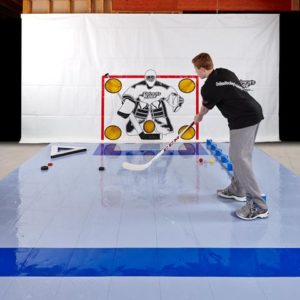
During one point of the TV feature the father of the NHL player was standing in their unfinished basement which served as their shooting room. The father was standing in front of a wall that, at one point before the color of vulcanized rubber took over, was probably the color of fresh wood and perhaps even the name of the shooting tarp was visible. The puck marks on shooting area of the concrete floor looked like the track at the Daytona 500.

“I can’t tell you how many thousands, and thousands of pucks have been shot down here,” said the father. Later in the show, talking about their backyard rink, it was again stated that the time, memories and frozen toes were too numerous to try to begin to quantify.

Meeting this NHL player via the TV show made me think back to some of my own experiences, and of those around me who were fortunate enough to play in college or even the NHL. They were the first ones on the rink and the last ones to leave. And they were also the players that had a net in their backyard and dozens of sticks in a barrel in their garage with the blades worn down to nothing. These worn out blades and banged up nets were a badge of honor for these players, and a testament to their dedication to the game. You could tell exactly how bad a kid wanted it by the condition of his training area.

And years later, after watching this segment on today’s NHL players, the same is true. So the question is, how bad to you want it? Are you willing to put in what it takes away from the rink?

After all, everyone has the the same number of hours in a day.

09

August

IMG_6806 - Version 2Training hockey players and helping in their development is very rewarding. We’d like to introduce some of the best players we met and had the privilege of working with this summer.

In a recent blog post we introduced you to five people you will meet at summer hockey school. As we enter our final month of hockey school we would like to introduce you to a few of our best players from our travels across the country this summer training hockey players and promoting skill development.

The Character Kid. Everyone knows character counts, and this summer we met plenty of exceptional players and parents who had great character on and off of the ice. When it comes to skill development and becoming a great hockey player, who you are as a person, how you carry yourself and treat teammates is all part of the ingredients for success.

The ‘Centered’ Center. Balance is important not only in skating and performance with stride and hockey skills, but balance is also important when it comes to hockey and a daily routine. Our staff met many hockey players this summer, and those who came to the rink with the most enthusiasm, excitement and willingness to learn were often those who had good balance in their life. Many were multiple sport athletes. Some were taking summer school. Others came from water skiing at the lake to the rink. Remain ‘centered’ with good balance when it comes to your hockey schedule and you will find success.

The Skinny Skillmaster. Most of the players we train at our hockey camps are between the ages of 8 and 16. What this means  for example, is that some Peewees weigh 70 pounds and others might weigh 150. One player thought he needed to really bulk up and gain weight, but what he really needed was patience for his body to grow into his frame. A good diet during this age of development is important. We saw many kids eating junk food, drinking highly caffeinated energy drinks and other foods and beverages that you would never find in a college or professional locker room. Food is fuel for your body, but not all food (and beverages) are good fuel.

We hope you had a great summer of hockey and improved your skills. Make sure to keep these hockey development tips in mind as you work your way through August and onto your team for the upcoming season!

Subscribe

With RSS feeds, you don't have to visit our site everyday to keep up to date. Simply subscribe to our blog via RSS or Email and our posts will come to you!